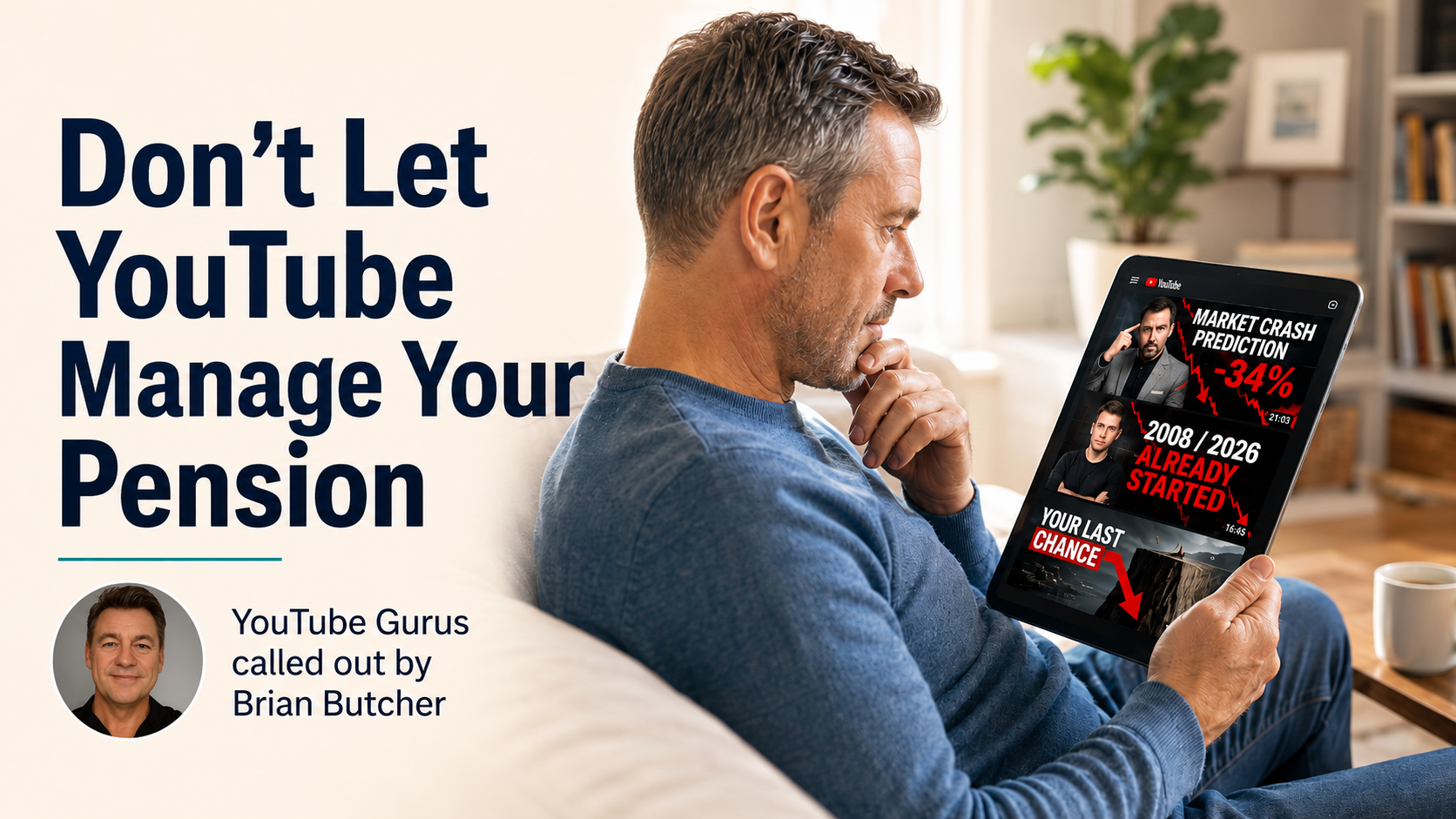
A client rang me recently. Invested his pension with me a couple of years ago. Good man, sensible man. He said, near enough word for word: “Brian, I want you to help me prepare for the crash.”
Not *a* crash. *The* crash. The big one. The one he’d been watching on his phone at half ten at night, lying in bed, thumb scrolling, eyes wide.
I didn’t laugh. I want to be clear about that. Because there’s nothing daft about a man in his fifties who’s spent thirty years building something and lies awake worrying it could vanish. That fear is real. It’s human. It comes from the right place — from caring about the people who depend on you. So before I say a single word about markets, let me say this: if you feel it too, you’re not soft and you’re not stupid. You’re paying attention. The trouble is *what* you’ve been paying attention to.
Because here’s what he’d been watching.
The thumbnails!
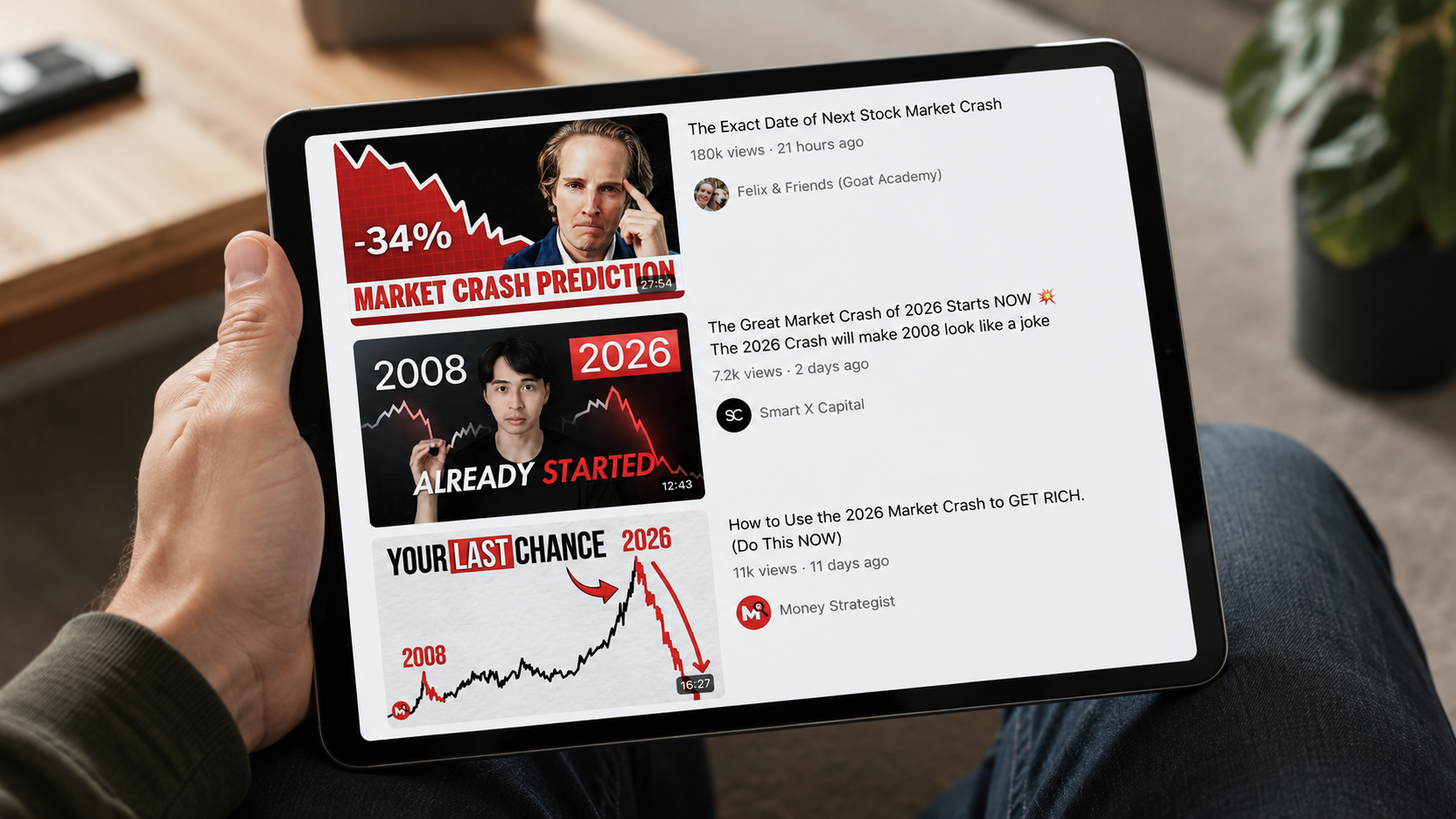
Yep, they’re the ones. A fella in a nice blazer, finger pressed to his temple like he’s receiving a transmission from the future. Big red letters. – 34%.MARKET CRASH PREDICTION.
Next to him, a lad who looks about nineteen, arms folded, “2008 / 2026 — ALREADY STARTED.”
And underneath that, the kicker: “YOUR LAST CHANCE.” A red arrow plunging off a cliff like Wile E. Coyote with a pension.
Twenty-one hours ago. 180,000 views. A countdown to the apocalypse, brought to you by a man you’ve never met, who knows nothing about you, your mortgage, your kids, or the date you want to hand in your keys and walk out of the office for the last time.
And I understand the pull. I do. It feels like information. It feels like somebody finally telling you the truth the suits won’t. But it isn’t truth. It’s theatre. And once you see how the trick works, you can’t unsee it.
Meet the Prophets
These people aren’t new. They’ve just got better cameras.
Take Harry Dent. For the best part of thirty years he’s been one of the loudest voices in the business of telling you what’s coming next. In 1999, Harry Dent predicted the Dow would surge to roughly 32,000 during the coming boom. Instead, the dot-com bubble burst and the index spent much of the following decade recovering from two major bear markets. At the end of 2008 he published a book about the Great Depression that was supposedly about to swallow us all. The market bottomed a few weeks later, in March 2009, and then it tripled. In 2021 he called for the market to fall 45%, then doubled down and said 80%. It hit new record highs. In the summer of 2024 he was on the telly predicting Nvidia would drop 98% and the Nasdaq 92%. They both went *up*. One analyst totted up nine of his big calls and found he’d got two of them right.
Two out of nine. I wouldn’t back a horse on those odds. And yet the man still sells books.
Then there’s Robert Kiyosaki — the *Rich Dad Poor Dad* fella. Decent enough on the basics of saving, I’ll give him that. But he’s been warning of the biggest crash in history since about April 2011. Do you know what the American market has done since he started warning? Risen something like 280%. He announced on 2nd August 2024 that “the crash has arrived.” The market climbed 15% after he said it. He’s still posting. Still warning. Different year, same prophecy.
There’s a name for this fella. The perma-bear. The forecaster who’s permanently certain the sky is about to fall. And there’s an old line about him that says it better than I can: the bears have successfully predicted 99 of the last 2 recessions.
Now, it’s important to note — every so often, one of them is *right*. Dr Doom himself, Nouriel Roubini, called the 2008 crisis years before it landed, and fair play, he did. But a stopped clock is right twice a day, and nobody hands it a Nobel Prize for it. The man who shouts “rain!” every single morning will, eventually, be standing there looking clever when the heavens open. That doesn’t make him a weatherman. It makes him wet, like everyone else, but louder about it.
What they’re actually selling
Here’s the bit they’d rather you didn’t think about.
That video isn’t free. Oh, it costs you nothing to watch — but watching isn’t the point. Watching is the bait. Underneath every “EXACT DATE OF THE NEXT CRASH” sits a newsletter subscription, a gold dealer’s affiliate link, a £997 “system,” a course, a book, a private members’ club where the *real* secrets live. Fear is the shop window. The till is round the back.
And the genius of it — the truly dark genius — is that the algorithm pays them to frighten you. A calm video that says “stay the course, keep investing, you’ll likely be fine” gets ignored. A red-faced warning that 2026 will make 2008 look like a joke gets 180,000 clicks before breakfast. The machine rewards alarm. So they supply alarm. Catastrophe is clickable. Calm is not.
Best of all, for them, is that being wrong costs them nothing. And here’s the question most people never stop to ask while they’re watching: who *are* these fellas? Because the vast majority of them aren’t regulated, aren’t qualified, and aren’t authorised by a soul to tell you what to do with a single penny of your money. I am. Every proper adviser is.
We sit under the FCA, we answer to the Financial Ombudsman, and if it all goes wrong our clients have the FSCS standing behind them — a real safety net with real teeth. The man in the blazer has none of that. No licence to lose, no regulator on his back, no compensation scheme for the people who followed him off the cliff. If his “forecast” wipes you out, there’s nobody to complain to, because officially he never advised you at all — he just “made a video.”
Nobody goes back and watches last year’s crash video to laugh. The misses vanish down the memory hole. The one lucky hit gets pinned to the top of the channel forever. Heads they win, tails you forget. It’s the only job I know where you can be wrong for fifteen years straight, answer to no one, and still call yourself a guru.
Why we fall for it
Now don’t beat yourself up for being drawn in, because the deck is stacked against you. Your own brain is in on it.
We are built to fear loss far more than we enjoy gain. Losing a thousand pounds hurts about twice as much as gaining a thousand feels good — that’s not weakness, that’s wiring. We give bad news more weight than good. We remember the vivid disaster — 2008, the queues outside Northern Rock — far more easily than the boring fifteen years of quiet growth that followed. And we trust a confident man in a suit pointing at a chart, because certainty *feels* like knowledge, even when it’s just volume.
Add it all up and you’ve got a brain that’s practically *begging* to be frightened by a stranger on the internet. The doom-monger isn’t selling you a forecast. He’s selling you the feeling of being warned. And that feeling is addictive.
Why it can’t be true — until the day it is
So let me say the quiet part out loud. Nobody knows the date. Nobody.
Not the man with the blazer. Not the lad with the folded arms. Not me. The market has crashed before and it will crash again — that part’s certain. What’s *not* certain, what is in fact unknowable, is *when*. And here’s the logic that ought to settle it for you: if a man genuinely knew the exact day the market would fall 34%, he would not be telling you about it on YouTube for ad money and a book deal. He’d be quietly making himself one of the richest men alive and saying nowt to anybody. The very fact that he’s shouting it through a megaphone is the proof he doesn’t know.
And one day — maybe next year, maybe in ten — the market *will* fall hard. And every single one of these fellas will rush out a video within the hour. “I TOLD YOU SO.” “I CALLED IT.” They’ll point at the one prophecy that landed and bury the forty that didn’t. People will flock to them, more certain than ever that they’re geniuses.
They’re not. They just kept shouting “rain” until it rained.
What it costs to listen
Here’s where it stops being funny, because this is the part that actually empties your pocket.
Say you’d watched one of these videos in a panic and sold everything. The data on what happens next is brutal and it is consistent. Over the last twenty years, an investor who simply stayed put did roughly twice as well as one who jumped out and missed just the ten best days in the market. *Ten days.* Out of five thousand. Miss the best thirty days over thirty years and your return collapses from around 8% a year to about 2% — less than inflation. You’d have been better off under the mattress.
And now the cruel twist. Those best days don’t politely wait for calm weather. They cluster right in the middle of the storm — roughly three-quarters of the market’s best days happen during a downturn or in the first couple of months of the recovery. The biggest up-days sit cheek by jowl with the biggest down-days. So the panicked seller, the one who bolted because a stranger told him to, is sat in cash on the very mornings the market does its best work. He sold at the bottom for safety and then watched the rebound through the window.
That’s the bill for listening. Not the crash. The *reaction* to the crash. Over 150 years, through wars and crashes and depressions, the market has always — eventually — recovered and gone on to make new highs. The people who got hurt weren’t the ones who rode it down. They were the ones who got frightened out at the worst possible moment by someone who didn’t care whether they ever got back in.
What a sensible investor does
So what did I tell my client? Not “do nothing” — that’s lazy advice and he deserved better. I told him this.
Know your time horizon. If you don’t need this money for fifteen years, a wobble next Tuesday is none of your business. Hold enough in cash that a bad year never forces you to sell at the bottom — that buffer is what lets you sleep, and sleep is worth more than any forecast. Keep paying in when it’s falling, because that’s when you’re buying the bargains the YouTuber is screaming at you to avoid. Diversify, so no single storm sinks the whole fleet. And then — this is the hard part — turn the phone off and go live your life.
That’s not exciting. There’s no countdown timer, no red arrow, no thumbnail of me with my finger on my temple. It won’t get 180,000 clicks. But it’s the truth, and the truth has never trended well.
Here’s the thing I keep coming back to, the thing that sits underneath everything I do. The man in the blazer does not know your name. He doesn’t know you’ve a daughter getting married or a knee that needs doing or a date circled on the calendar when you finally stop working. He’s never going to. He gets paid whether you thrive or panic — paid a little bit *more*, in fact, if you panic.
Nobody will ever care more about your money than the right adviser sat across the table from you. Not a stranger on a screen. Not an algorithm. Not a prophet selling the same crash he’s been selling since 2011.
My client’s sleeping better now. Not because I promised him there’d never be a crash — I’d never insult him with that. But because he finally understands the difference between a man who’s frightened *for* him and a man who’s profiting *from* fright.
The crash is always coming. It always has been. Let the shouting men shout. You’ve got a plan, and you’ve got someone who knows your name.
If any of this is keeping *you* up at night, please don’t hesitate to contact me. That’s what I’m here for — and unlike the fella with the blazer, I’ll actually want to know your name.
—
*This article is general information about investing and human behaviour. It is not personal financial advice — that depends entirely on your own circumstances, which is rather the whole point. The value of investments can fall as well as rise and past performance is not a guide to the future. The forecasting records described are matters of public record, reported across financial media.*
*Sources drawn on for the data and track records in this piece: ThinkAdvisor, Oak Harvest Financial Group and Dividend.com (Harry Dent’s forecasting history); U.S. News, TheStreet and Money Talks News (Robert Kiyosaki’s predictions); Sparrow Wealth Management (the perma-bear “Dr Doom” Roubini); J.P. Morgan Asset Management, Franklin Templeton, Wells Fargo Investment Institute and Hartford Funds (the cost of missing the market’s best days); and Morningstar (150 years of market recoveries).*