Your dad probably had one. Maybe your mum. Possibly your older colleagues who retired a decade ahead of you and seemed, in hindsight, remarkably relaxed about the whole thing.
A final salary pension. A guaranteed income for life, linked to how long you worked and what you earned. No decisions required. No spreadsheets. No worrying about whether markets would fall the year you retired. Just a number, arriving in your bank account every month, until the day you died.
That world is almost over.
And the people who haven’t quite registered that fact are the ones who worry me most.
The end of the final salary pension era – from eight million to just nine hundred thousand.
Private sector defined benefit pension membership — the final salary schemes that underpinned retirement for a generation — peaked at more than eight million active members. By 2021 it had fallen to around nine hundred thousand.
That’s not a typo. That’s a collapse. And it means that the generation now approaching retirement — the fifty to sixty-five year olds who are starting to think seriously about what comes next — will be the first wave to arrive without a guaranteed foundation beneath their feet.
Instead, they have pots. Defined contribution pensions. Money accumulated, invested, and now in need of a plan.
That’s not bad news, necessarily. Some people have very healthy pots. The problem isn’t the money. The problem is that nobody has explained to them that the skills required to build a pension are completely different from the skills required to turn one into a retirement.
Saving is passive. You set up the direct debit and you wait.
Drawing down wisely? That’s active. That’s decisions. That takes expertise.
What the first DC generation actually faces
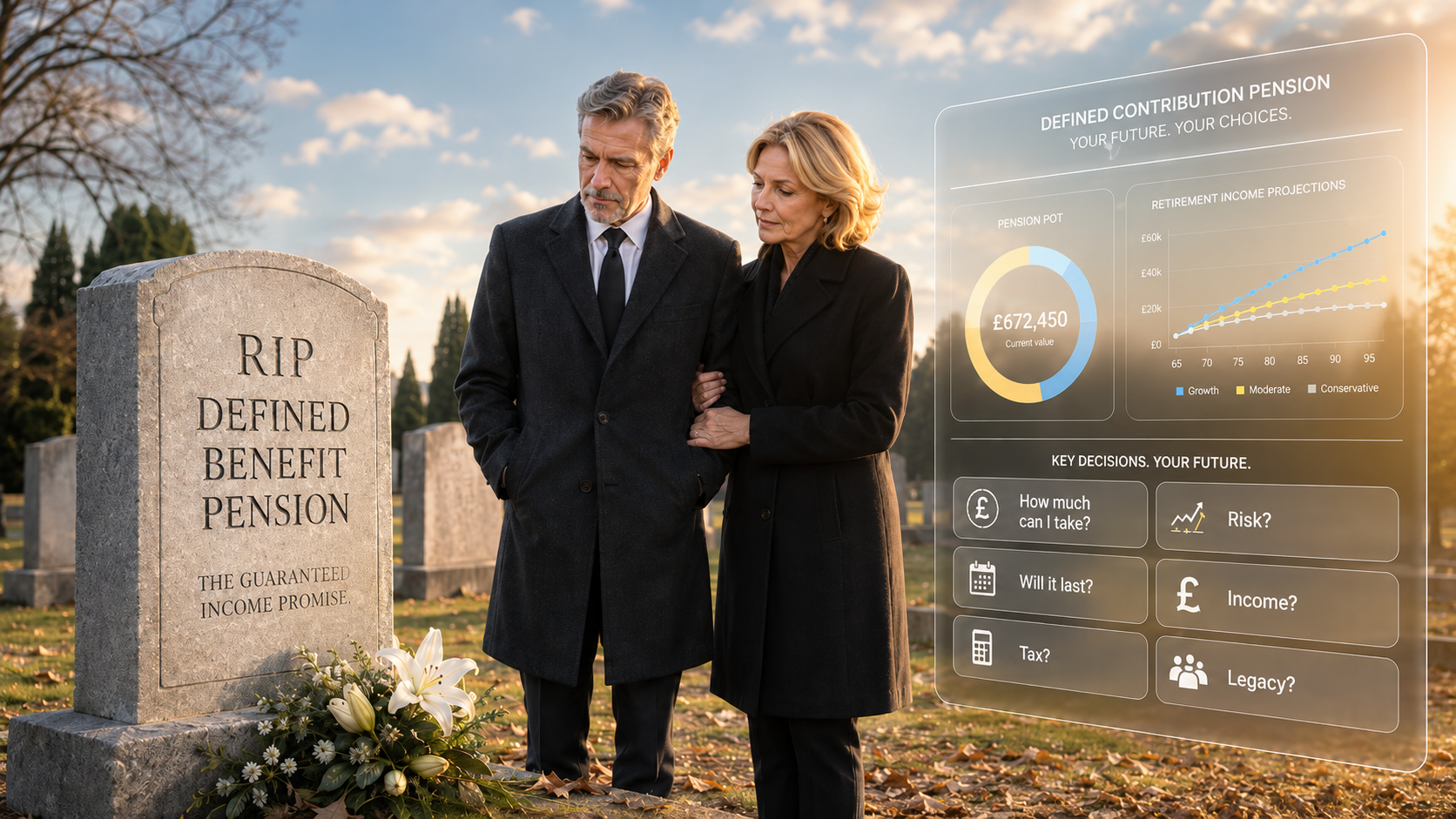
If you’re retiring with a defined contribution pension — and most people under sixty-five now are — here is a non-exhaustive list of what you’ll need to think about:
- How much can I draw each year without running out of money before I run out of life?
- What if I live to ninety-five?
- What if I live to a hundred and two?
- What risk should I be taking to get the return I need?
- What options do I have for taking withdrawals from my pension?
- What order should I draw from my accounts? Pension first? ISA first? Cash? The answer changes your tax bill by thousands.
- What happens if markets fall thirty percent in my first year of retirement and yI’me still taking income? That’s called sequence-of-returns risk. It’s one of the most damaging things that can happen to a retirement plan, and almost nobody who hasn’t had this conversation knows the term.
- Should I buy an annuity — a guaranteed income — for part of my pot? Five years ago the answer was almost always no. Today, with rates where they are, it’s a serious question worth asking.
- And what about what I leave behind? Pensions used to be one of the most tax-efficient assets you could pass on. From April 2027, that changes. Significantly.
The inheritance trap nobody is talking about loudly enough
For years, the received wisdom was straightforward: spend your ISAs, spend your cash, spend your investments — but leave the pension alone. Pass it on. It sat outside your estate for inheritance tax purposes. That logic is about to be dismantled.
From April 2027, most unused pension funds will fall within your estate. That changes everything. The strategy that worked for the last twenty years — preserve the pension, spend everything else — may now leave your family with a significantly larger inheritance tax bill than you intended.
If you have a sizeable pension and haven’t revisited your withdrawal strategy in the last twelve months, you should. This isn’t scaremongering. It’s arithmetic. And the arithmetic changed.
What brilliant retirement planning actually looks like
It doesn’t start with a chart. It starts with a question: “What does a good life look like from the day I stop working?”
From there, we work out what that life costs. Then we look at everything you have — pensions, ISAs, cash, property, business assets, expected inheritances — and we build a plan for turning it all into that life, in the most efficient order, with the least tax, over the longest reasonable time horizon.
We stress-test it. What if you live to ninety-five? What if inflation stays high? What if you need care in later life? What if your spouse dies first? What if markets fall in year one?
None of this is complicated once you understand it. But it takes time. It takes expertise. And it takes someone who does this for a living and genuinely gives a damn about whether you get it right.
Your parents’ retirement was simple because someone else carried the risk. Yours is more complicated. But that doesn’t mean it can’t be brilliant. It just means it needs a plan.
Take your free Retirement Scorecard here — twelve minutes to find out where you stand, what the gaps are, and what to do about them.
Because the final salary pension is gone. But a secure, tax-efficient, well-structured retirement isn’t. Not if you plan it properly.