Today’s earnings figures suggest that the new State Pension could increase from around £12,548 a year to approximately £13,037 next April – a rise of approximately 3.9% . That sounds like good news but it does raise some interesting issues.
The Personal Allowance (the amount you are allowed to earn before paying income tax) is frozen at £12,570. Therefore, the State Pension could exceed the tax-free allowance by around £467, potentially creating an income-tax bill of approximately £93.
But the real issue isn’t the £93. If this is the only income a pensioner receives then, if the Government want their £93 back, it’s the administrative merry-go-round that could be required to collect it, Secondly, the Governments initial suggestion to ignore the tax (and not ask for it back from the people that fall into this bracket) leaves us to ask the question – is this really fair on the people that have saved for their later years?
Let me explain…
1. One department pays it. Another asks for it back.
The State Pension is taxable, but the Department for Work and Pensions pays it without deducting tax.
HMRC must then work out what is owed and find another way to collect it.
If the pensioner has a private pension or employment income, HMRC will normally adjust the tax code applied to that income. The private pension provider may therefore collect not only the tax due on its own pension, but also the tax due on the State Pension.
If there is no other suitable income, HMRC may send the pensioner a Simple Assessment bill after the end of the tax year.
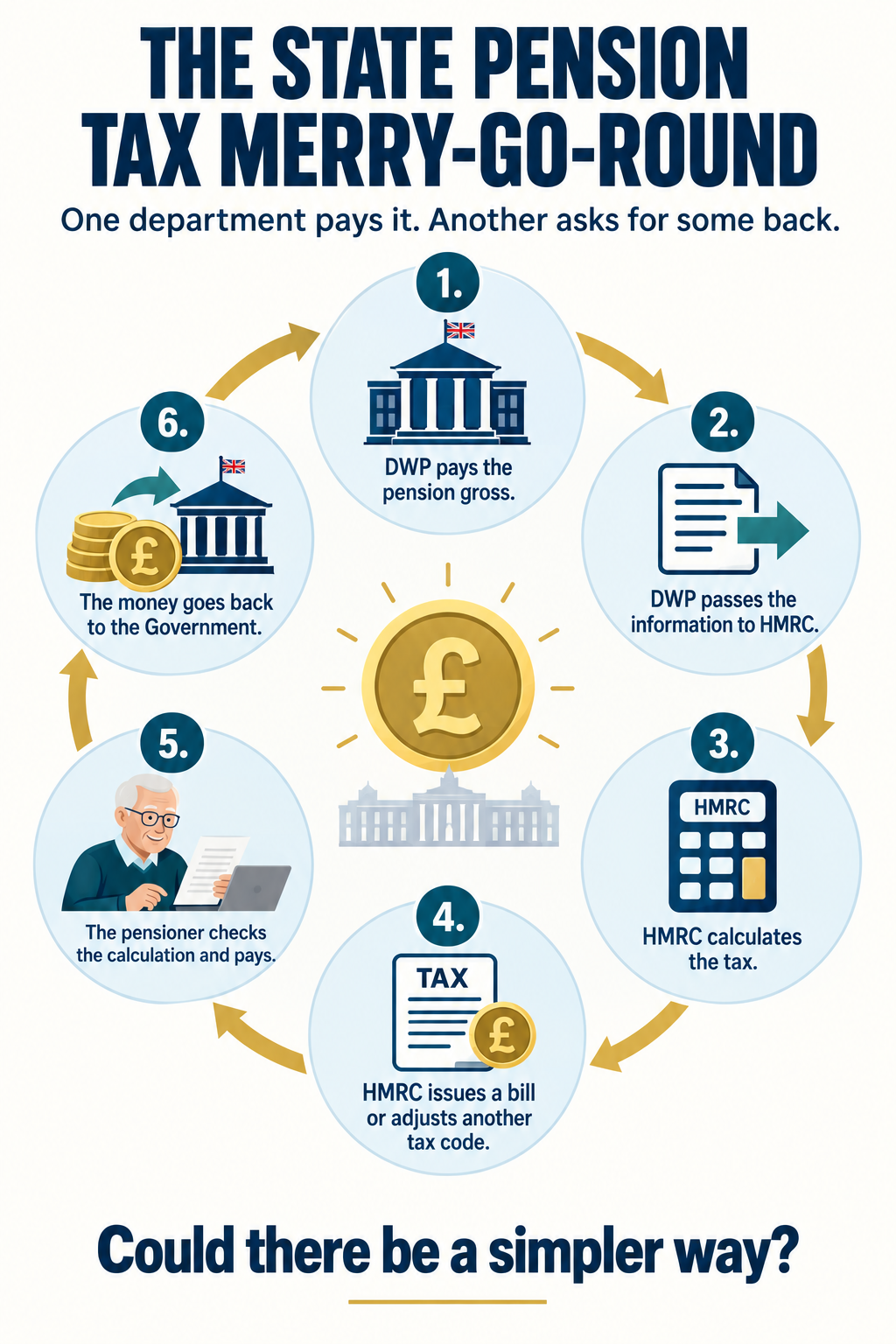
So, the State could pay someone approximately £13,037 and then create a separate process to recover around £93.
Presumably, nobody had a large enough envelope available to deduct it before sending it.
Now I’m not claiming that every £93 bill costs £93 to collect. Much of the process will be automated, and the Government hasn’t published a reliable cost for each case. But administration doesn’t disappear simply because a computer is involved. Information must pass between departments. Calculations and tax codes must be produced. Letters must be issued. Payments must be processed. Errors must be corrected and telephone enquiries answered.
Meanwhile, the pensioner must understand why the Government paid them taxable income without deducting the tax and is now asking for some of it back.
More than 1.3 million Simple Assessments were reportedly issued for 2023/24—nearly double the number two years earlier. Almost a quarter were for less than £100.
Not all related to the State Pension, but they show the growing burden of collecting small amounts outside PAYE.
2. The proposed solution may create another problem
The Government has recognised the issue above and it intends that, from 2027/28, pensioners whose only income is the basic or new State Pension should not have to pay small amounts through Simple Assessment.
That sounds sensible—until we ask who qualifies.
What happens to someone with a small private pension? What about someone with an additional State Pension under the old system or a protected payment? What about those that have done what they were told to do and built up other assets to fund their retirement?
Someone receiving only the standard new State Pension may have their small liability ignored yet someone with just £1 of other taxable income could potentially lose the concession and become liable for 20 pence tax on their State Pension too.
That would send a rather odd message:
Save nothing privately and we’ll overlook the tax. Save a little and we’ll send you a bill.
Not quite the incentive to save for retirement is it?
Three policies are colliding
The problem exists because three policies no longer fit together:
- The State Pension rises under the triple lock.
- The Personal Allowance remains frozen at £12,570.
- The State Pension is paid gross rather than taxed through PAYE.
Individually, each policy may have a justification. Together, they manufacture small tax bills, unnecessary administration and confusion.
This is not an argument that the State Pension should never be taxable. People with substantial pension and investment income should pay the tax properly due. It is an argument for sensible administration and proportionate tax collection.
The Government should consider a permanent solution. Aligning the Personal Allowance with the full new State Pension, introducing a sensible minimum tax-collection threshold, or applying any concession according to total income rather than the particular type of pension received are all potential problem solvers here but, after more than 30 years advising people about pensions and retirement, I have learned that complicated rules rarely inconvenience the people who devise them. The inconvenience tends to arrive on the doormat of the person expected to understand them.
Pensioners should not need to decipher unexpected tax codes or worry about HMRC letters because two government departments cannot coordinate a payment efficiently. A retirement-income system should be understandable, fair and reasonably straightforward. Paying pensioners with one hand and chasing them for part of it with the other is none of those things.
Of course, I fear the Government may choose a rather different “solution” and will weaken or remove the triple lock. No doubt they will present the resulting reduction in future pension increases as a necessary simplification designed to protect taxpayers and ease pressure on the public finances. In other words, pensioners could be asked to accept less money for their own good—while the Government congratulates itself on removing an administrative problem of its own making. Call me cynical, but when “simplification” is announced by the Treasury, it is usually worth checking which of your pockets has just become lighter.
So, what do you think the Government should do to stop the State Pension tax merry-go-round?
Let me know in the comments box.
#StatePension #RetirementPlanning #Pensions #FinancialPlanning #Tax